 Fabo Company
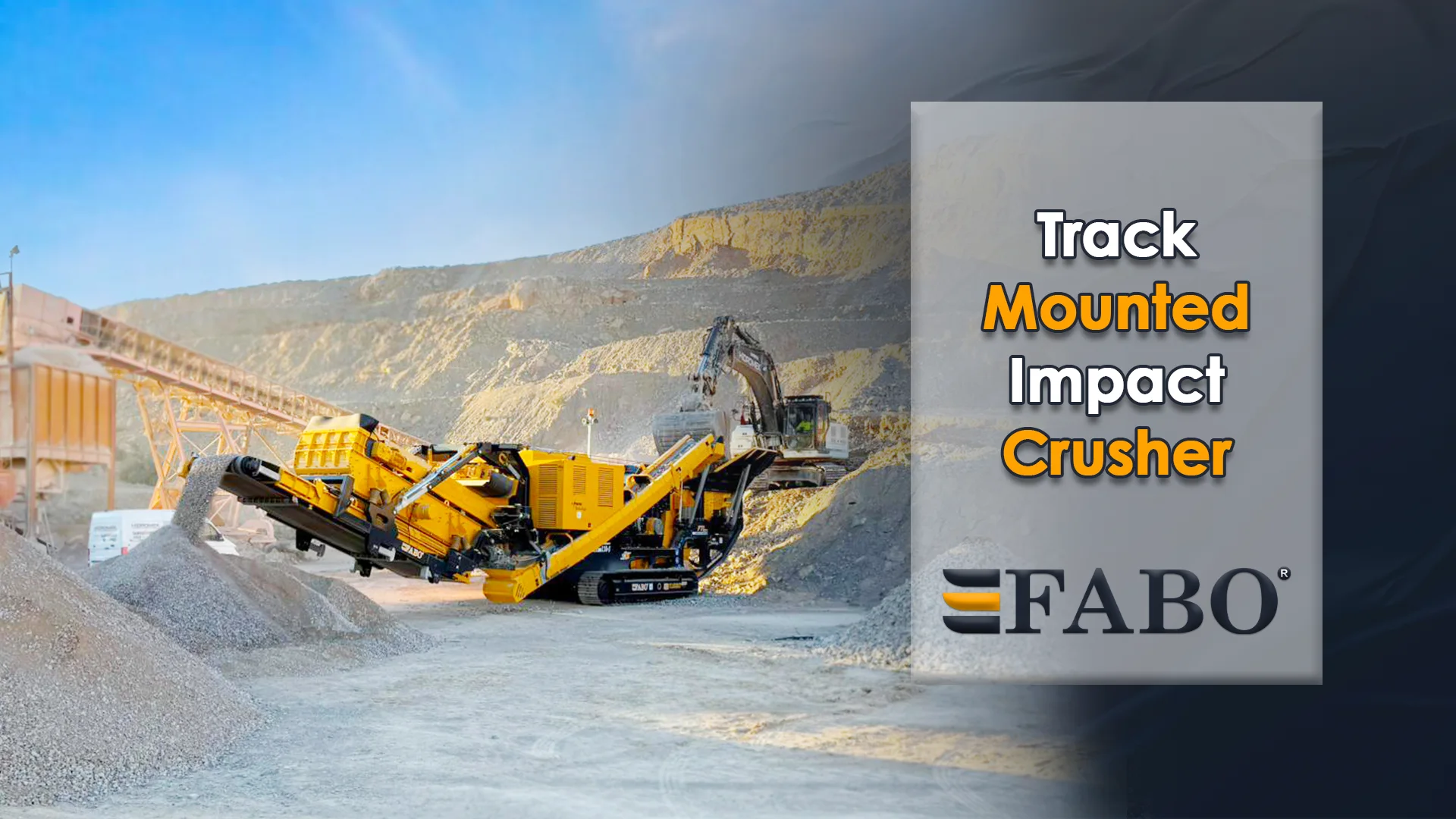
A Track Mounted Impact Crusher has become one of the most essential machines in modern aggregate production, mining operations, and recycling activities. Especially in quarrying, mining sites, and construction waste recycling projects, companies are increasingly shifting away from fixed installations and investing in highly mobile, efficient, and flexible crushing systems as project demands and timelines become more challenging.
A track mounted impact crusher is designed to deliver high-performance crushing directly at the job site, whether in mining operations or recycling facilities, eliminating unnecessary transportation costs and improving operational speed. Unlike traditional systems, this equipment integrates mobility, power, and productivity into a single compact solution.
What Is a Track Mounted Impact Crusher and How Does It Work?
A Track Mounted Impact Crusher is a mobile crushing machine mounted on a tracked chassis, designed to crush medium to hard materials such as limestone, concrete, asphalt, and natural rock.
It operates using high-speed impact force rather than compression. Material is fed into a crushing chamber where a rotating rotor equipped with blow bars impacts the feed material, breaking it into smaller, cubical-shaped aggregates.
Track Mounted Impact Crusher Working Principle:
- Material is fed through a hopper or feeder system
- The rotor spins at high speed inside the impact chamber
- Blow bars strike the material, causing controlled breakage
- Broken material is further refined through impact plates
- Final product is discharged via a conveyor system
This process allows the Track Mounted Impact Crusher to produce high-quality, well-shaped aggregates suitable for concrete production and asphalt applications.
From an engineering perspective, the system is optimized for:
- High reduction ratios
- Consistent particle shape
- Adjustable output size
Technical Features That Set the Track Mounted Impact Crusher Apart from Competitors
A high-performance Track Mounted Impact Crusher stands out from standard mobile crushing equipment not only because of its mobility, but also due to its advanced engineering, flexible operating structure, and modular system design. These characteristics are developed to increase uptime, minimize operational risks, and ensure reliable performance in both mining and recycling applications.
Key technical advantages include:
-
Hydraulic CSS Adjustment (Separately Controlled from Automation System):
Allows precise and independent control of the closed side setting (CSS), enabling operators to quickly adjust product size without interrupting the automation system. This improves operational flexibility and reduces downtime during production changes.
-
Hydraulically Folding Bypass Conveyor with Polyurethane Scraper System:
Designed for fast transport setup and durability, the bypass conveyor folds hydraulically during relocation. The integrated polyurethane scraper system ensures cleaner belt operation and reduces material carryback, improving overall efficiency.
-
Heavy-Duty Crusher Design for Mining and Recycling Applications:
The crusher is engineered for extreme working conditions, making it suitable for both hard rock mining and high-volume recycling operations. Reinforced wear components ensure long service life under abrasive conditions.
-
Hybrid Power System (Diesel + Electric Operation):
The hybrid configuration allows the machine to operate using diesel engines or external electric power. This significantly reduces fuel consumption, lowers emissions, and provides flexibility for energy-efficient job sites.
-
Integrated Magnetic Separator System (Optional):
In recycling applications, the system can extract and eject ferrous materials during the crushing process. This improves product purity and enhances the quality of recycled aggregates.
-
Single-Layer Screening System for Final Product Control:
The design enables the production of a consistent, well-graded final product using a single-deck screen, simplifying the process while maintaining high output quality.
-
Dual Product Output via Reversible Recycling Conveyor:
The reversible conveyor system allows operators to produce two different aggregate fractions simultaneously, increasing production flexibility and reducing the need for additional equipment.
-
Optional Pan Feeder for Reinforced Recycling Applications:
In operations involving reinforced concrete, a heavy-duty vibrating pan feeder installed beneath the crusher prevents conveyor belt damage caused by steel reinforcement. This significantly improves system durability and reduces maintenance costs.
Key Benefits of Using a Track Mounted Impact Crusher on Job Sites
A Track Mounted Impact Crusher provides significant operational advantages, especially in dynamic job site environments where mobility and efficiency are critical.
Key advantages include:
- High Mobility: Track-mounted design allows easy movement across rough terrain
- On-Site Crushing: Eliminates material transport to stationary plants
- Faster Setup Time: No need for complex foundation work
- Flexible Operation: Can be relocated as project needs change
- Reduced Operating Costs: Lower logistics and transport expenses
Unlike a stationary crusher, a mobile system improves productivity by bringing the crushing process directly to the material source. This reduces downtime and increases overall project efficiency.
The Right Track Mounted Impact Crusher for Mining and Recycling Needs
Selecting the right Track Mounted Impact Crusher depends on application requirements, material type, and production goals.
Key selection factors:
- Type of material (hard rock, limestone, demolition waste)
- Required production capacity
- Desired final product size
- Mobility requirements across job sites
- Integration with existing crushing or screening systems
For mining operations, durability and high throughput are essential. For recycling applications, adaptability and precision crushing are more important.
Modern systems, such as those developed by leading manufacturers like FABO Company, are engineered to handle both mining and recycling tasks efficiently. These machines are designed to work in harsh environments while maintaining consistent performance and low wear rates.
Compared to a stationary crusher, a track-mounted solution provides superior flexibility, especially in multi-site operations.
Capacity, Output Size, and Performance Factors You Should Know
The performance of a Track Mounted Impact Crusher depends on several technical factors that directly influence productivity and output quality.
Key performance parameters:
- Feed size capacity: Determines the maximum material size that can be processed
- Rotor speed: Impacts crushing force and final product shape
- Crusher chamber design: Affects reduction ratio and efficiency
- Screening system integration: Helps control final product sizing
- Power system efficiency: Impacts fuel consumption and operational cost
A well-designed system ensures:
- Consistent aggregate quality
- Reduced oversize material
- Optimized energy usage
When integrated into an aggregate production line, this equipment plays a central role in achieving uniform output and meeting industry standards for construction materials.
Can a Track Mounted Impact Crusher Handle Recycling Materials?
Yes, a Track Mounted Impact Crusher is highly effective in recycling applications, especially in construction and demolition waste processing.
It can efficiently process:
- Concrete debris
- Asphalt waste
- Brick and masonry materials
- Mixed construction waste
Why it works well in recycling:
- High-impact force breaks reinforced materials effectively
- Adjustable output allows precise aggregate sizing
- Magnetic separators can remove metal contaminants
- Mobile design enables operation directly at demolition sites
This makes it a key machine in sustainable construction practices and circular economy initiatives.
Compared to traditional systems, it reduces landfill dependency and allows reusable materials to re-enter production cycles.
Investment Insight: ROI and Operational Benefits
From an investment perspective, a Track Mounted Impact Crusher offers strong long-term value for contractors and mining companies.
Key ROI advantages:
- Lower transportation costs
- Reduced need for multiple fixed installations
- Higher machine utilization rate
- Faster project completion times
- Reduced labor and logistics dependency
Although initial investment in mobile crushing systems may be higher than conventional setups, the operational savings quickly balance the cost over time.
Additional benefits include:
- Flexibility to move between multiple projects
- Increased equipment lifespan due to optimized design
- Higher resale value in the secondary equipment market
For companies focused on scalability and efficiency, this type of equipment provides a strategic advantage in competitive markets.